

How to Expand with Multilingual Content in Today’s AI Landscape
Key takeaways from Silvi Nuñez’s
Digital Marketing Europe 2026 session
If you work in digital marketing, e-commerce, product, or localisation, you’ve probably felt the pressure already. More markets. More languages. Tighter deadlines. Leaner teams. And somewhere in the background, someone asking, “Can’t we just use ChatGPT?”
That pressure is real. But the solution is not to reject AI or blindly adopt it everywhere. It’s to understand where AI genuinely helps, where it needs supervision, and where human judgment still makes the difference.
That was the core message behind this Digital Marketing Europe 2026 session: multilingual growth is still very much a strategic, human-led discipline. AI can make it faster. It can make it more scalable. But it cannot make it automatic.
The AI Conversation Has Moved Past Hype
A useful way to frame the current moment is through the Gartner Hype Cycle. It helps explain why so many teams have gone from excitement to frustration in such a short time.
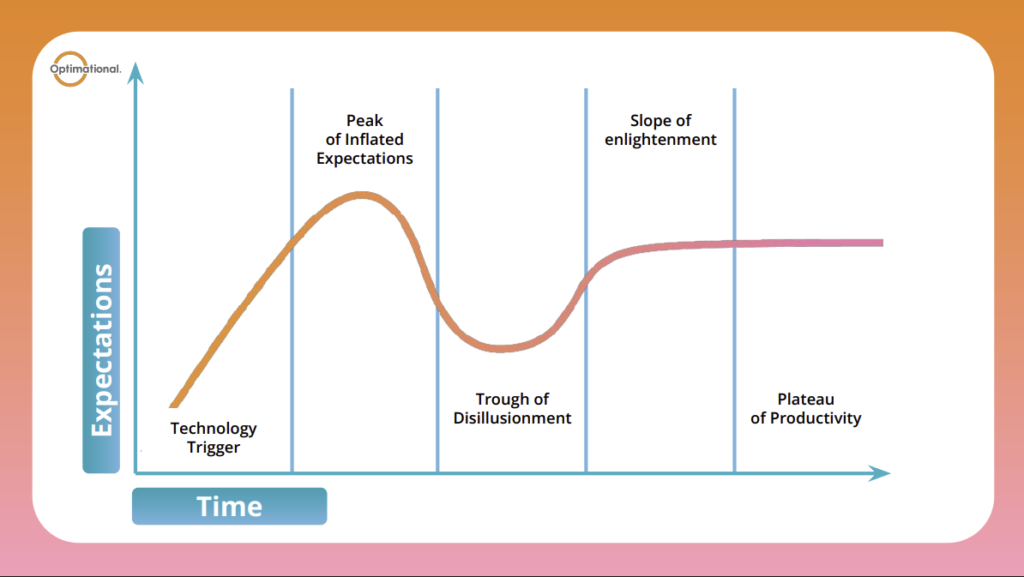
In 2023, generative AI felt like a breakthrough that would change everything overnight. Expectations shot up fast. Suddenly, every conversation seemed to land in one of two extremes:
“AI will replace translators.”
“We don’t need humans anymore.”
“We should automate the whole thing.”
Now, the conversation feels more grounded. Teams are discovering what many localisation professionals already knew: what looks impressive in a demo does not always hold up in real workflows, across real markets, under real business pressure.
That does not mean AI has failed. It means we are moving into the phase where practical value matters more than bold claims. And honestly, that is where the interesting work starts.
At the same time, the demands on localisation teams have not eased up. If anything, they have increased. Teams are expected to deliver more content, in more languages, with the same or fewer resources, while still protecting quality, consistency, and trust.
So the question is no longer whether to use AI. The real question is how to use it well.
Localisation Is Not “Just Translation”
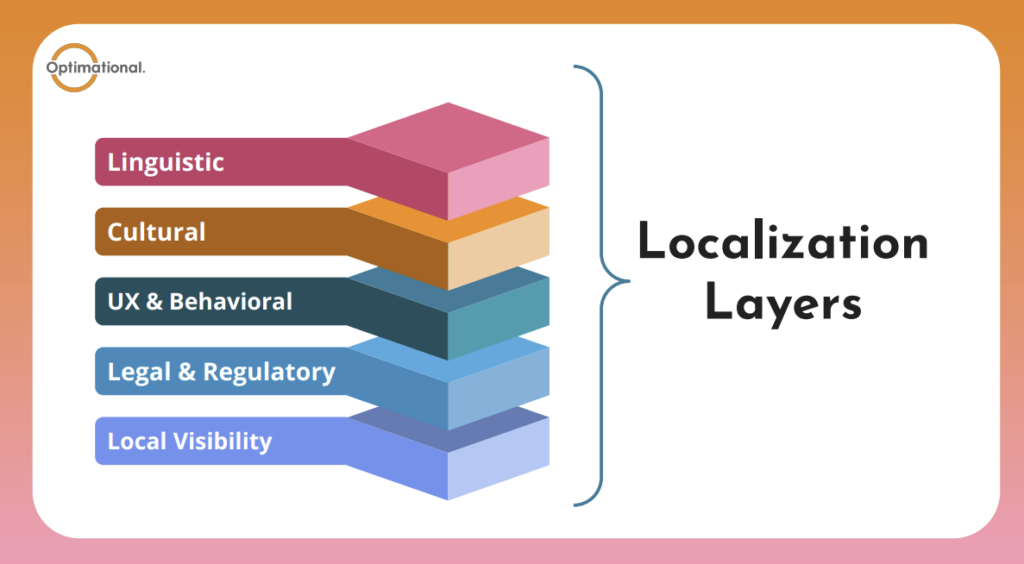
One of the most important reminders from the session was this: localisation is not a translation task. It is a business function that makes international growth possible.
When companies reduce localisation to word replacement, they miss the bigger picture. In reality, localisation works across five connected layers.
1. Linguistic Adaptation
This is the layer people usually think about first. Yes, it includes translation. But it also includes tone, terminology, brand voice, and language variant.
UK English is not US English. Spanish for Spain is not the same as Spanish for Latin America. If you get that wrong, the content may still be understandable—but it won’t feel native, credible, or fully aligned with the audience.
2. Cultural Adaptation
This is where localisation moves beyond language and into interpretation. It asks how the content will be perceived in a specific market.
Colours, symbols, references, humour, imagery, gestures, and expectations all carry meaning. Something that feels neutral in one country can feel confusing—or even problematic—in another. That is why cultural adaptation is not a nice extra. It is part of risk management.
3. UX and Behavioural Adaptation
This layer focuses on whether the experience actually feels local.
Think about currencies, date formats, payment methods, delivery expectations, form fields, and user flow. Small points of friction matter. A site might be well translated and still underperform if the experience feels foreign or inconvenient.
This is also where localisation starts affecting conversion more directly. If the experience does not match local habits, people hesitate. And when people hesitate, they leave.
For brands working on search visibility as well as usability, this is also where multilingual SEO becomes part of the conversation—not something you add at the very end.
4. Legal and Regulatory Compliance
Not every message is allowed everywhere. Privacy requirements, disclaimers, age restrictions, consent flows, and platform rules vary by market.
This layer protects the business. It reduces legal risk, supports compliant launches, and helps teams avoid expensive mistakes that have nothing to do with language quality and everything to do with local regulation.
5. Local Visibility
Even excellent localised content can fail if nobody finds it.
This is where international search strategy matters: local keyword research, search intent, metadata, URLs, hreflang, and content structure. You are not simply translating an English SEO strategy. You are rebuilding visibility around how people actually search in each market.
If you want a deeper breakdown of that distinction, Optimational’s guide on SEO translation vs localisation is a useful companion read.
The bigger point is simple: AI can support every one of these layers, but it cannot own them on its own.
Where AI Is Already Helping Localisation Teams
Once you define localisation properly, the conversation around AI becomes much more practical.
Teams are already using AI in meaningful ways: terminology work, quality checks, workflow support, automation, competitor research, content ideation, and multilingual SEO tasks. But four use cases stand out because they are already affecting day-to-day operations in visible ways.
Video Dubbing and Audio Localisation
AI dubbing has improved fast. It can now support multilingual voice adaptation, faster production cycles, and more scalable video delivery than many teams could manage a few years ago.
That opens real opportunities, especially for educational content, product explainers, and marketing videos. But it still needs supervision. Voice, timing, tone, terminology, and cultural fit all matter. When errors scale through video, they become very public, very quickly.
Localisation of Visual Assets
AI can also support visual adaptation across markets. That includes adjusting backgrounds, styling, settings, and campaign visuals to better match local expectations.
Used well, this can speed up testing and reduce production costs. Used poorly, it can produce generic, stereotypical, or culturally tone-deaf content. The technology is powerful, but cultural judgment still has to lead the process.
Multilingual AI Chatbots
Multilingual customer support is one of the clearest operational use cases for AI. Faster response times, wider language coverage, and lower support load are all attractive outcomes.
However, performance is not evenly distributed across languages, markets, or support scenarios. High-performing teams do not “set and forget” these systems. They review outputs, monitor risk, refine prompts, and escalate sensitive cases to humans.
AI Translation
This is still the most talked-about use case—and the one that tends to be the most misunderstood.
AI translation can unlock access. That matters. In many contexts, content does not need to be perfect to be useful. It simply needs to be understandable enough for the user to move forward.
That is one reason the conversation around “good enough” matters so much. Broader market research supports this idea too: CSA Research has reported that 65% of consumers prefer content in their own language even if the quality is not perfect.
That does not mean quality stops mattering. It means usefulness comes first more often than teams expect.
When “Good Enough” Stops Being Good Enough
This is where many organisations get stuck. They correctly recognise that AI translation can create efficiency. Then they apply that logic too broadly.
The problem is that not every error is harmless.
Some errors are mildly awkward. Others damage trust, distort meaning, or create risk. In multilingual content, the biggest problem is often not obvious failure. It is credible-looking failure.
A sentence can sound fluent and still be wrong. A product description can read naturally and still misrepresent the offer. A culturally sensitive message can seem polished and still miss the mark.
That is why teams need a more useful question than “Is the AI good?” The better question is: “What happens if this output is wrong?”
Once you ask that, your workflow becomes much easier to design.
A Practical Framework: Tier the Content by Risk
The strongest part of the session was the move away from abstract debate and toward workflow design.
Not all content carries the same risk. Therefore, not all content should go through the same localisation process.
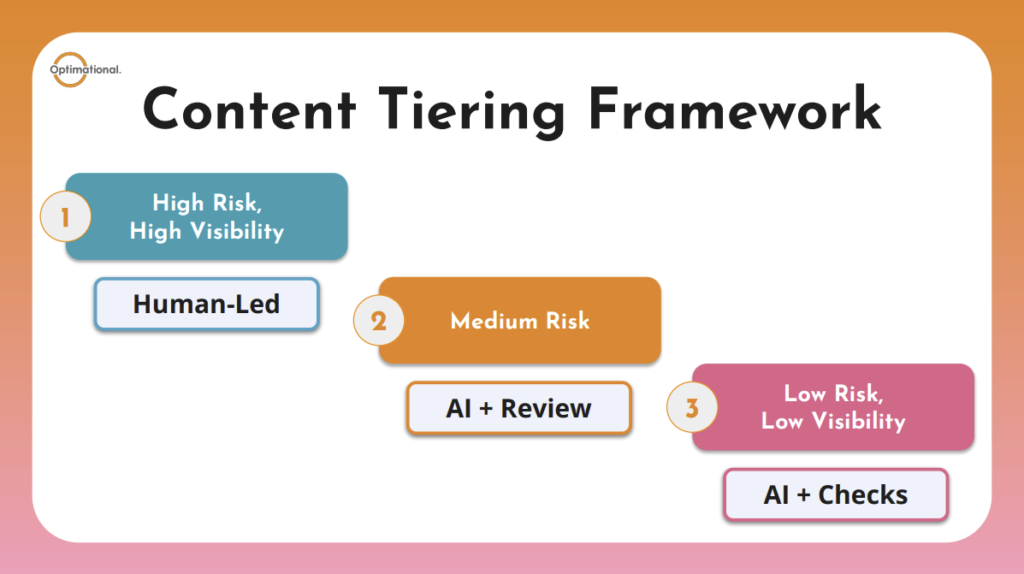
Tier 1: High Risk, High Visibility
This is content where errors are expensive. Think legal content, medical or safety information, flagship campaigns, highly visible brand messaging, or anything customer-facing where trust is central.
Here, humans should lead. AI can support research, drafting, or preparation, but final ownership needs to stay with people.
Tier 2: Medium Risk
This includes important public-facing content where speed matters, but some review is still necessary.
Here, AI can do the first pass and humans can review, refine, and approve. This is often where teams get the best balance between efficiency and quality.
Tier 3: Low Risk, Low Visibility
This is where AI can contribute the most scale: large-volume content, internal documentation, support material, lower-visibility pages, or content where minor imperfections do not create major consequences.
Even here, some quality control still matters. But full human review of everything is rarely realistic or necessary.
This kind of tiering is not rigid. It depends on your industry, your audience, your content model, and your tolerance for risk. But without some version of it, teams tend to make one of two mistakes: over-reviewing everything or under-reviewing the wrong things.
What an AI-Enabled Localisation Workflow Looks Like in Practice
In mature teams, AI works inside a system. It does not replace the system.
A practical workflow usually looks something like this:
- Content starts in the CMS or source platform.
- It moves into a TMS or localisation workflow.
- Existing resources such as translation memory, glossaries, and style guides are applied.
- The content runs through the most suitable AI or MT engine for that use case.
- Quality checks or estimation layers help identify risk.
- Content is then routed based on score, visibility, and risk tier.
That routing matters. Some content can move straight to publication. Some needs human review. Some only needs a spot check. The value of AI comes not from removing people, but from using human expertise where it has the highest impact.
If you want to go deeper into that operational side, Optimational’s article on AI in localisation trends for 2026 expands on workflow design, quality, and governance.
Governance Is What Keeps AI Useful
This is where many companies still underestimate the challenge.
AI does not manage itself. Someone has to define what quality looks like, who reviews what, how risk is classified, and what happens when something goes wrong.
That is governance.
In practice, governance means deciding:
- who owns AI-supported output;
- which content types fall into which risk tiers;
- what quality thresholds are acceptable;
- when content can be published automatically;
- how teams monitor quality across languages and markets;
- how sensitive data is handled;
- and how cultural fit is checked before publication.
Without governance, AI does not scale quality. It scales inconsistency.
And inconsistency is expensive. It shows up as fragmented brand voice, uneven quality, missed compliance issues, and growing internal confusion about who is responsible for what.
Two Final Recommendations for Teams Expanding Now
The session closed with two recommendations that are simple, but easy to overlook.
1. Be Transparent about AI Use
If content is automatically translated or AI-assisted, say so when appropriate.
A short label or disclaimer can go a long way in setting expectations. It helps users interpret minor errors more fairly and reduces the sense that the brand is being careless or misleading.
Transparency builds trust because it shows awareness, not weakness.
2. Do Market Research before Launching
Too many multilingual launches start because translating the site “feels like the next step.” But language alone does not make a market viable.
Before launching, teams should validate:
- market demand;
- customer behaviour;
- language preferences in practice, not just in theory;
- product-market fit;
- competitor presence;
- and operational readiness.
This is where localisation becomes a growth strategy, not a content task.
Final Takeaway
The teams doing multilingual expansion well are not the ones chasing every AI feature. They are the ones designing better systems around real business needs.
They know that localisation is not just translation. It is linguistic, cultural, behavioural, legal, and strategic. They use AI where it adds speed and scale. They bring in humans where judgment, nuance, and accountability matter most.
That is the balance worth aiming for.
Because in the end, AI will scale whatever standard you set. The real question is whether your workflow is designed to protect that standard as you grow.
Silvi Nuñez is a localisation strategist and founder of Optimational. Explore her work at silvinunez.com.