
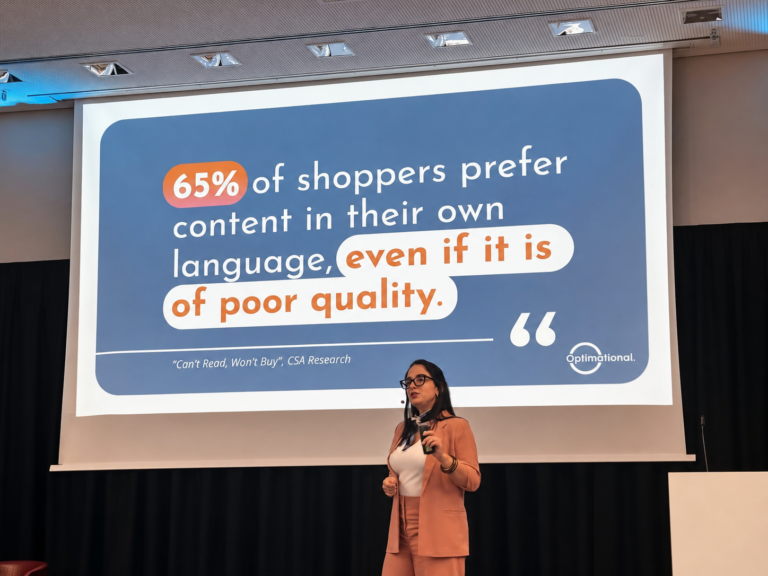
Boosting Visibility with Multilingual Content in the Age of AI
Key Takeaways from Silvi Nuñez’s
Siinda Live Berlin 2026 Session
At Siinda Live Berlin 2026, the conversation was all about AI, advertising, and the power of local. That made it the right setting to talk about a question more brands are starting to ask: What happens to visibility when your audience ‘searches, compares, and buys’ in different languages?
For years, multilingual content was often treated as a translation task. Take the source content, convert it into another language, publish it, and move on. But in today’s search landscape, that approach is no longer enough. If people are discovering brands through Google, AI Overviews, local search platforms, marketplaces, maps, review sites, and conversational AI tools, multilingual content needs to do more than “exist” in another language. It needs to help the brand become visible, relevant, and trusted in each market.
That was the main message of my session, “Boosting Visibility with Multilingual Content in the Age of AI.” Translation can open the door, but visibility depends on whether your content reflects how people actually search, what they expect to see, and which signals make a brand feel credible locally.
Multilingual Content Is Now a Visibility Strategy
AI search has made content visibility more complex, but also more interesting. We are no longer only writing for traditional search rankings. We are also creating content that AI systems can understand, extract, summarise, and cite. That means clarity, structure, authority, and relevance matter more than ever.
For multilingual brands, this creates a clear opportunity. Every new language version can become a new entry point for discovery. In the presentation, I referenced Weglot’s 2026 analysis of 1.3 million AI citations, which found that “Translated websites gain 327% more visibility in AI Overviews for non-available language queries“. The takeaway is not that translation alone guarantees visibility. It’s that multilingual content gives AI systems more chances to find and cite your brand, as long as the content is useful, structured, and locally relevant.
This matters especially for companies expanding across markets. If your content only reflects one market’s language, terminology, and search behaviour, you are limiting how visible you can be elsewhere. AI may be changing the interface of search, but the principle is familiar: People still need content that answers their questions in their own language and context.
Local Relevance Starts with How People Search
One of the simplest examples from the session was the difference between “sweater” and “jumper.” In the US, someone may search for “buy sweater.” In the UK or Australia, that same product may be searched as “buy jumper.” Nothing about the product has changed, but the language of discovery has.
The same happens across languages. In Spanish, one market may search for “suéter,” while another may use “jersey.” And in many cases, the difference goes beyond vocabulary. Search intent can change too. Buyers in one market may look for price, while another market may prioritise durability, reviews, delivery conditions, sustainability, brand reputation, or local availability.
This is why multilingual SEO cannot be treated as translated SEO. A keyword that works in one country may sound unnatural in another. A landing page that converts in one market may miss the proof points another audience needs. A product category may be searched differently depending on local habits, regional vocabulary, and platform behaviour.
Local relevance is not about making content sound nice. It is about matching the way people actually look for solutions.
The Visibility Wheel: How Localised Content Builds Momentum
In the session, I introduced the visibility wheel: localised content leads to search and AI discovery; discovery brings traffic and engagement; engagement builds authority signals; and stronger authority increases the chances of being cited, ranked, and shown again.
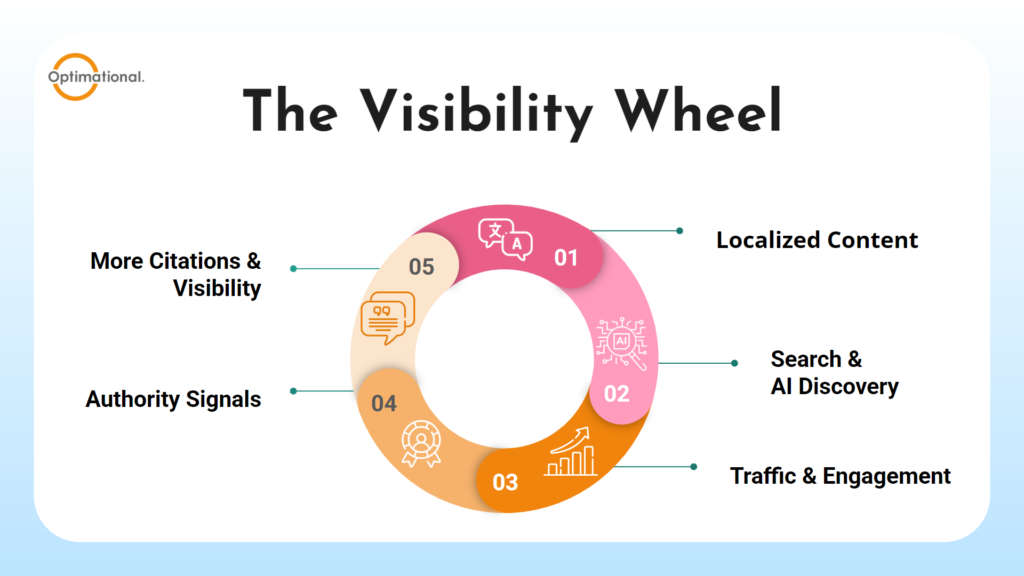
This is the loop brands should be thinking about. Multilingual visibility does not come from publishing a set of translated pages once and leaving them untouched. It comes from building a local content ecosystem that keeps reinforcing itself. The more relevant your local content is, the more likely people are to engage with it. The more people engage, the more signals you create. The stronger those signals become, the easier it is for search engines and AI systems to recognise your brand as a useful source.
For agencies, local platforms, and digital marketing teams, this is where multilingual content becomes a growth lever. It is not only about language coverage. It is about creating more moments where a brand can be discovered by the right audience, in the right market, with the right message.
Local Authority Has to Be Built Market by Market
One point I wanted to make very clear at Siinda is that authority does not automatically travel. A brand may be well known in one market and almost invisible in another. It may have strong reviews in one language, but none in another. It may have backlinks from relevant local sources in its home country, but no market-level proof elsewhere.
That is why local authority needs to be built deliberately. In the presentation, I grouped local authority into three types of signals: content signals, reputation signals, and authority signals. Content signals come from pages that answer local queries. Reputation signals come from reviews, testimonials, ratings, and social proof in the market. Authority signals come from mentions, backlinks, partnerships, and references from trusted local sources.
This is especially important in AI search. If AI systems are looking for useful and trustworthy answers, they need signals that show your brand is relevant in that specific context. A translated page may help, but it is stronger when supported by local reviews, local examples, local links, and content that reflects real local demand.
In other words, multilingual visibility is not only about content; it is also about trust.
AI Can Help, but It Will Not Make You Local by Default
AI can speed up multilingual content production. It can support translation, drafting, research, keyword clustering, metadata, content adaptation, and quality checks. But AI does not automatically know what standard your brand needs in each market, which content is safe to automate, or what local users expect.
That is why teams need to use AI with intention. The goal is not to slow everything down with unnecessary review, but also not to publish everything just because AI made it fast. A homepage, campaign, or key service page needs a different level of care than a low-visibility support article. A local landing page for a strategic market deserves more attention than internal documentation.
For teams starting, the practical path is simple: assign ownership, decide which content needs human validation, build workflows that combine AI speed with expert review, and start with one market or content type before scaling. This keeps AI useful without letting quality, trust, or local relevance become an afterthought.
What This Means for Brands and Agencies
For brands, the message is clear: multilingual content should be part of your visibility strategy from the start. If you want to grow in a market, you need to understand how people search there, what they trust, which terms they use, and what content helps them move forward.
For agencies and local marketing partners, this creates a strong opportunity. Many businesses already know they need to show up in AI search and local discovery, but they may not know how multilingual content fits into that picture. Helping them move from “translated pages” to “market-ready visibility” is where real value can be created.
That means looking beyond language and asking better questions. Are we answering local queries? Are we using the terms people actually search? Do we have local proof? Are our reviews, testimonials, and examples relevant to this audience? Are we creating content that both users and AI systems can understand?
These are the questions that turn multilingual content from a cost centre into a growth asset.
Final Takeaway
The future of visibility is multilingual, local, and increasingly AI-mediated. But the fundamentals have not disappeared. Useful content still wins. Trust still matters. Local relevance still makes the difference between being seen and being ignored.
AI can help brands create and scale multilingual content faster, but it cannot replace market understanding. The brands that succeed will be the ones that use AI to support better localisation, not skip it.
Because localisation is not just about making content understandable. It is about making people feel at home. And what is good for users is good for SEO, GEO, and long-term visibility.
If you want to strengthen your multilingual SEO strategy and improve your visibility across markets, get in touch with Optimational.
Silvi Nuñez is a localisation strategist and founder of Optimational. Explore her work at silvinunez.com.