Helping Polyvision Build Local-Language Visibility Across International Markets
About
Polyvision is a global B2B manufacturer known for its CeramicSteel surfaces, used across education, healthcare, commercial, public and architectural spaces.
Its website includes technical and product-led content, from specifications and testing information to resources, industry solutions, and sales contact pages.
As Polyvision expanded internationally, the company needed its website to work beyond English. The goal was to make the content clear, natural, and useful for local audiences, while supporting regional sales teams and building stronger local-language visibility.
Services: Website localisation, multilingual SEO support, terminology management, multilingual QA
Languages: English into Spanish and French. Chinese completed and pending publication. Dutch, Portuguese, Japanese, Hindi, and Indonesian are planned as future expansion languages.
The Goal
Polyvision wanted to localise its website to:
Create local-language visibility.
Support regional sales teams.
Build stronger local-language presence.
Improve the quality and consistency of its multilingual content.
Create a scalable workflow for future language expansion.
Prepare the website for new international audiences.
The project started with Spanish in July 2025, followed by French in March 2026. Both languages were completed in batches. Chinese has now been completed as of June 2026 and is pending publication.
The Challenge
Polyvision needed a localisation partner that could support a large, technical website with accuracy, flexibility and close collaboration.
The project included the full website, covering product pages, technical testing pages, specifications, industry solutions, resources, documents, projects, contact pages, and blog posts.
The content was highly specialised, with terminology related to CeramicSteel, whiteboards, chalkboards, architectural panels, surface testing, durability, sustainability, and product specifications.
Polyvision had worked with another translation provider before, but the quality did not always feel native, the process was slow, and the workflow required too much manual effort from the client’s side.
What We Did
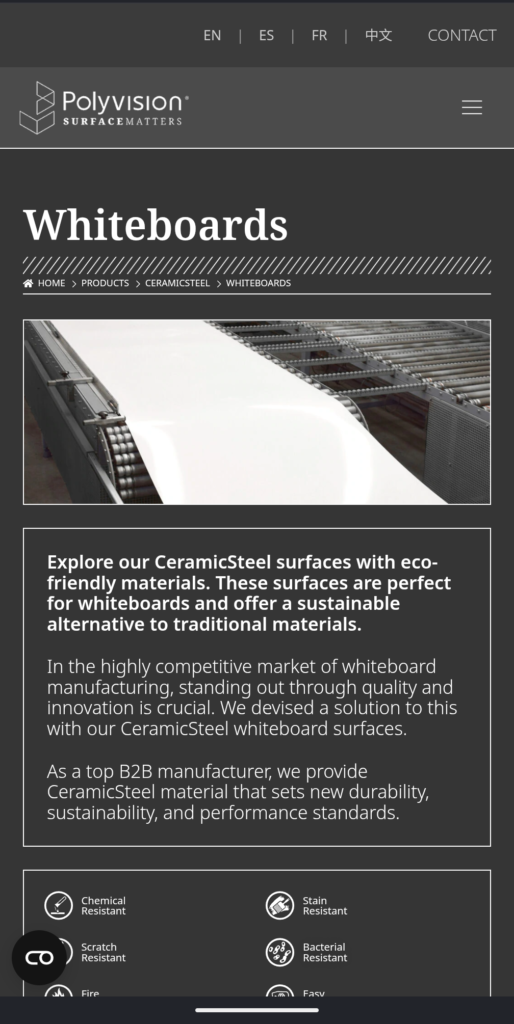
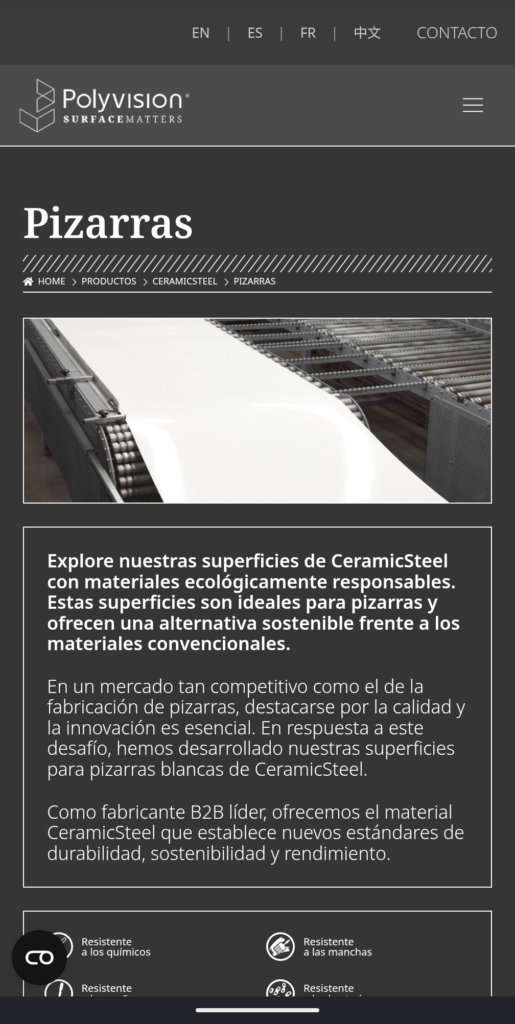
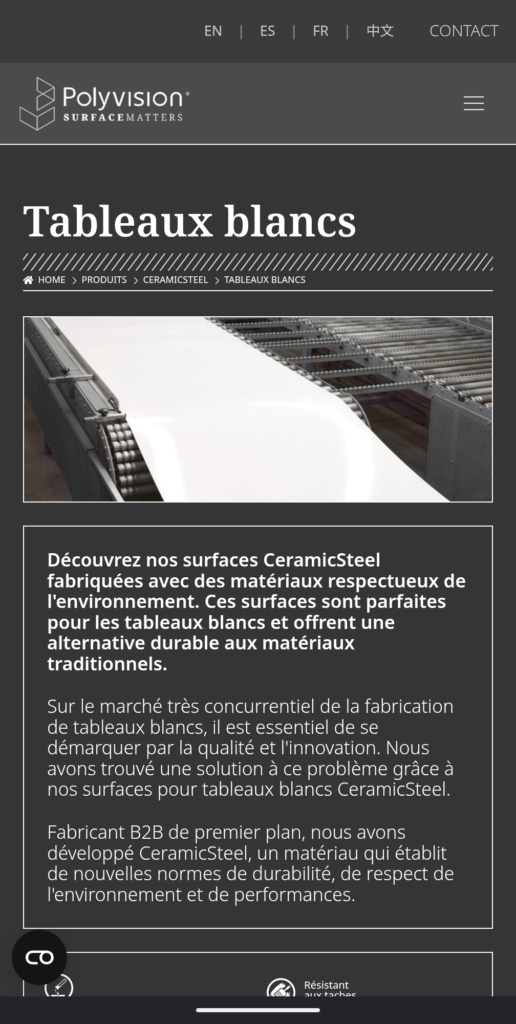
Optimational localised the website into Spanish, French, and Chinese through a scalable workflow built for a large, technical B2B website.
The process combined WordPress–TMS integration, native-level localisation, terminology management, SEO-aware adaptation, and post-launch QA.
We connected Polyvision’s WordPress site to our translation management system using the WPML plugin.
This allowed us to manage website content more efficiently, reduce manual copy-paste work, and create a smoother localisation workflow. It also helped us use translation memories and glossaries to keep terminology consistent across pages and languages.
We reviewed and created a technical terminology glossary to keep key terms consistent across pages and languages.
This was especially important for technical terminology, like CeramicSteel, whiteboards, chalkboards, architectural panels, surface testing, durability, sustainability, and for product specifications.
SEO was considered throughout the localisation process.
We adapted UX, keywords and terminology based on the target audience. Also, we localised URLs and metadata, and followed multilingual SEO best practices, including hreflang considerations, to help the translated pages become easier to understand, index and discover.
This included checking that key product terms, page titles, headings, meta descriptions, and URL slugs worked naturally in each language, while still reflecting how local audiences would search for Polyvision’s products and solutions.
After the translated content was implemented, we completed a multilingual QA review of the translated site to check that the pages displayed correctly and nothing was broken.
This included reviewing links, layout, formatting, language selectors, and the overall user journey across languages.
Search Visibility Results
After launch, the Spanish and French sections started building organic search visibility in markets where Polyvision previously had no local-language website presence.
The Spanish section gained visibility across Spain, Mexico, Colombia, Chile, and Peru. The French section started appearing in France and other French-speaking markets, including Canada, Belgium, Morocco, and Luxembourg.
Several product and technical pages also began ranking for relevant local-language searches, showing how localisation supported both discoverability and regional sales enablement.
GA4 data also showed that organic visitors reached localised product, technical and contact pages, including CeramicSteel, whiteboards, panels, education solutions, and contact pages.
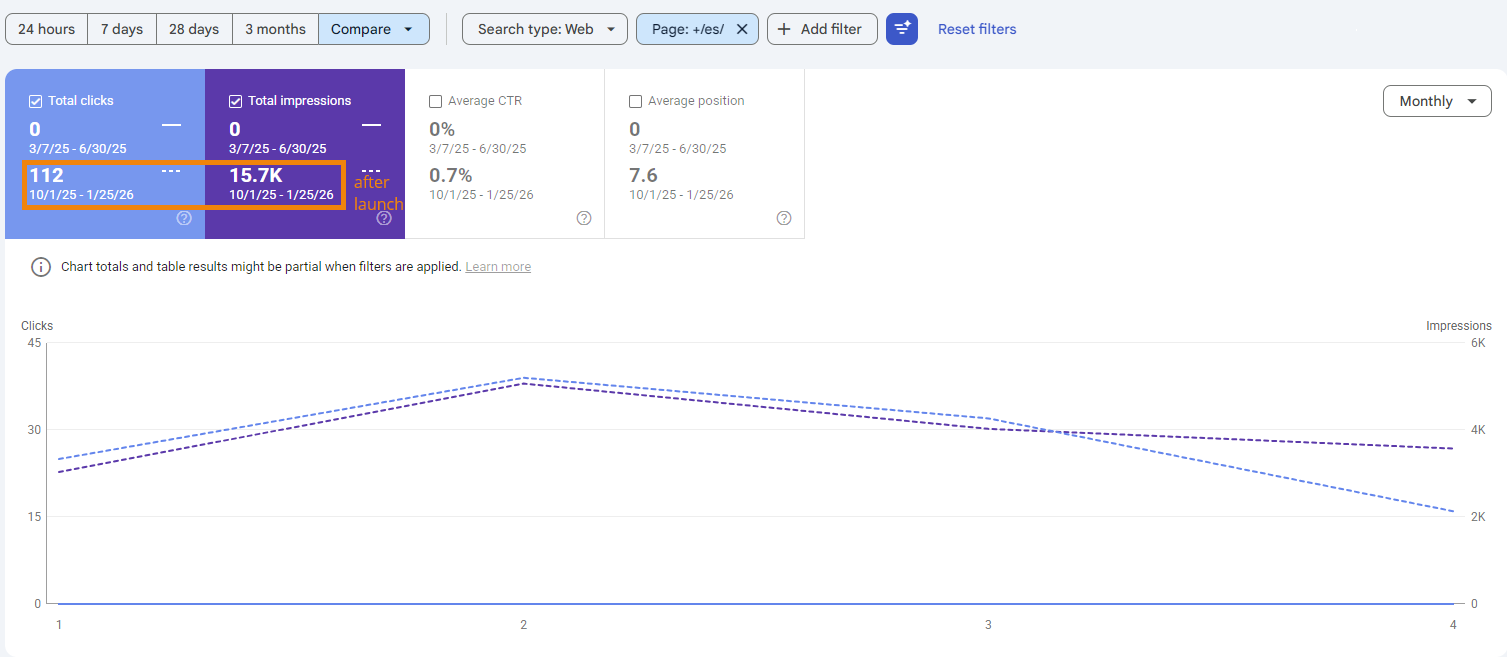
After the Spanish localisation went live, the /es/ section started appearing in Google Search, generating 15.7K impressions and 112 clicks between 1 October 2025 and 25 January 2026 (less than 3 months after the launch.)
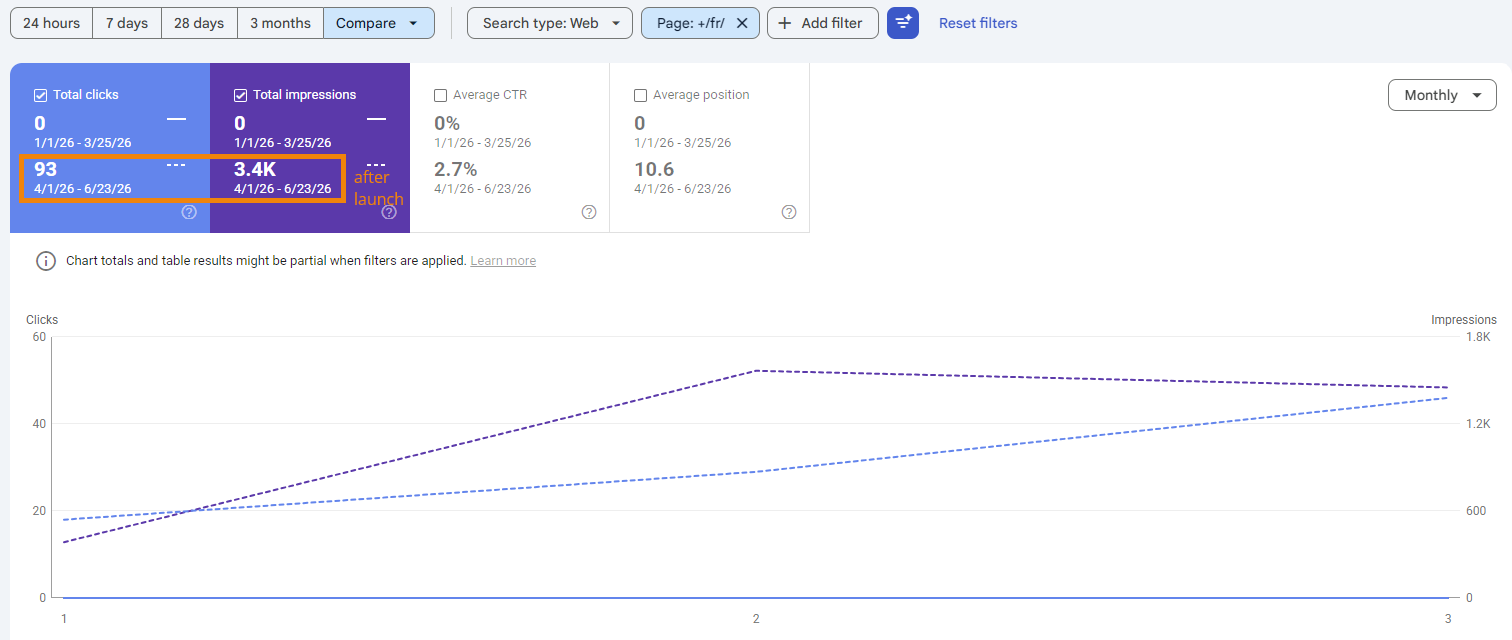
After the French localisation went live, the /fr/ section started appearing in Google Search, generating 3.4K impressions and 93 clicks between 1 April and 23 June 2026 (less than 3 months after the launch.)
AI Visibility Snapshot
As part of the broader localisation and visibility review, we also checked how Polyvision appeared in AI-led discovery contexts.
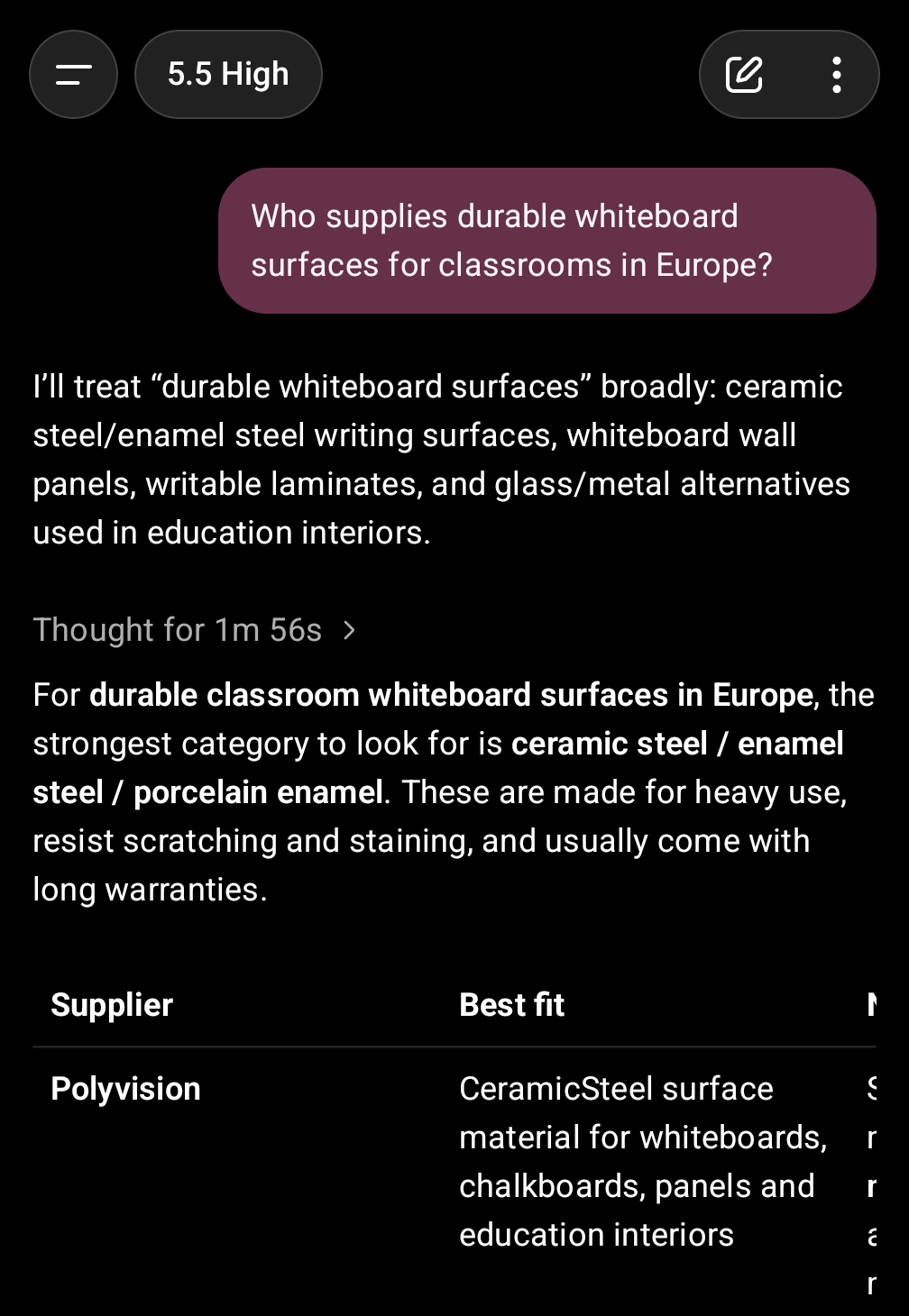
For example, when asking about suppliers of durable whiteboard surfaces for classrooms in Europe, Polyvision appeared as a relevant supplier associated with CeramicSteel surfaces for whiteboards, chalkboards, panels, and education interiors.
AI results can vary depending on the tool, location, timing, and prompt, so this is not presented as a guaranteed result. Instead, it offers a snapshot of how clearer product positioning and consistent terminology can support visibility in AI-led research journeys.
What’s Next
After Spanish, French, and Chinese, Polyvision is continuing its multilingual expansion.
The company is planning further localisation into Dutch and other strategic languages, including Portuguese, Japanese, Hindi, and Indonesian.
This ongoing roadmap provides Polyvision with a scalable, multilingual foundation to support international audiences, regional sales teams, and future market growth.
“Great team to work with. They are reliable, punctual, and consistently deliver high-quality work on time. Communication is smooth, and the whole process feels professional and easy from start to finish.”